What VCs Look for Before Investing in a Moroccan Startup
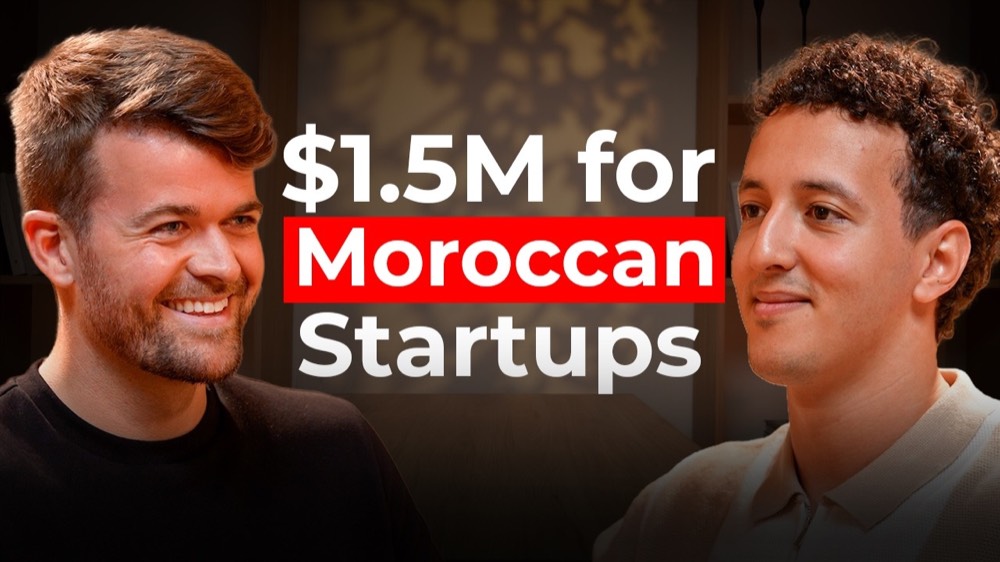
Sam Marchant invests at pre-seed and seed stage across the Middle East and North Africa with 21 Ventures in Dubai. He has not made an investment in North Africa yet. Yassine asked him why, and what a Moroccan founder would need to show him to change that.
Key takeaways
- Sam looks at people first: how you first made money, a hobby you keep pushing, and what obsesses you about your vision.
- Most startups should not raise venture capital. It fits companies that want to grow very large, very fast.
- A typical pre-seed or seed round gives away 15% to 25% of the company.
- His three instant red flags: an AI-generated deck, outsourcing core founder work to advisors, and using a broker to raise money.
- In a first VC meeting, cover four things: why this problem, why this solution, why you, and why now.
From founder to investor
Sam has spent his career in startups. He launched a low-sugar cereal bar company at university, had an outcome in 2022, and moved into early-stage investing with funds in London. He then co-founded a venture builder that launched eight AI companies in three years, before moving to Dubai and starting 21 Ventures.
21 Ventures is one of the newest pre-seed and seed funds in the region and invests only in companies incorporated in a MENA country. It made six investments this year, of which two have been announced. The fund also runs a media business behind Founding MENA, which spotlights companies and founders across the region.
Why he invests only in MENA
Sam gives two reasons. First, talent in the region is plentiful, but investors often assess it badly. He tells the story of a 19-year-old Syrian founder who bootstrapped a software product to about $30,000 in monthly recurring revenue on his own, and could not get VCs to take his calls because he had no university degree and no big-company experience. Sam thinks that is the wrong filter.
Second, strong founders in the region build businesses with great metrics at big valuation discounts compared with the US. He points to Tabby, which he says had just announced a $6.5 billion valuation, as proof that large outcomes exist here.
The questions he asks on a first call
Many VCs ask which university you attended and which companies you worked at. Sam says those are the wrong questions. He wants to know three things:
How did you first make money? Is there a hobby you will never be the best at but keep pushing? What is the one thing that obsesses you about your vision, or about how you see the world after success?
He prefers not to talk about the company or product on the first call at all. He wants to know the people. Founders can reach him by DM on Instagram or email, and he reads them all. The website form, he says, is the worst way to reach him, and he does not need warm introductions.
His process is fast. The quickest round the fund committed to took eight days from first meeting to term sheet, and the team met the founder every day in different settings, including a paddle match, to see how he treats his team.
Should you raise venture capital at all?
Counterintuitively, Sam says most founders should not. He argues venture capital fits companies trying to change how people experience the world, and that today there is more capital than high-quality companies. Many founders raise because they think money will fix the problem, when the real problem is that no one wants what they are building.
His six 2026 investments did not need venture capital to survive. They chose it to grow faster and reach the ceiling of their market sooner, then move into a new market or product from a position of strength. He suggests that founders whose companies do not fit that path look at profitability or angel investors who know them well.
Why North Africa has not had an investment yet
Sam sees talented founders and large markets in North Africa, but names currency risk as the main issue. It makes building scalable revenue models harder. He also worries that countries pulling resources inward may not be inviting for growth outside the region.
On Morocco specifically, keeping capital in the country is very difficult, and as an investor he asks whether a company that hits a ceiling locally will move to Delaware or ADGM. What impresses him is Morocco's strong link to the EU, and he sees more founders monetizing it. But a purely local focus is not scalable, he says, unless you compare it with markets of Saudi or Egyptian size.
On Egypt, he cites massive scale and hard-working talent, but a very unstable local currency and talent that is priced too low as a result. He also asks founders whether they understand how business differs between Morocco, Egypt, Saudi Arabia, the UAE and Oman. "Speaking Arabic in these countries" does not mean they work the same way.
What the region needs more than accelerators
Sam says MENA does not need more accelerators, mentors or even VC funds. It needs a business environment where small and medium companies can trade with each other with confidence that they will be paid on time. He compares it to the Y Combinator portfolio, where early-stage companies sell to each other to reach their first million in revenue.
He also questions the habit of counting registered companies as a measure of success. Better measures are internal growth rates, the share of GDP, how long companies last and how many people they employ.
Sectors, and the "baby shark" founder
21 Ventures is sector-agnostic. Sam believes good companies can come from anywhere, and that specialists often assume things cannot change. He does see fintech and AI as strong sectors in the region and wants more products built for local problems rather than copies of US ideas.
He also notes that industry networks help with the first 0 to 100 sales, while young founders bring AI skills and have not absorbed old beliefs about what cannot change. His image for the founders he likes: "a baby shark is still a shark."
How early-stage valuations work
Sam suggests a founder think in terms of dilution. A pre-seed or seed round typically gives away 15% to 25% of the business, and you can check data on platforms like Crunchbase. If you raise $1 million and aim for 20% dilution, that means a $4 million pre-money valuation and $5 million post-money.
Investors, he says, look at where the money takes you. A strong pitch says what the raise will deliver in 24 months, such as $2 million in annual recurring revenue, profitability or a delivered proof of concept. See the glossary link on valuation for background.
What he needs to see before a pre-seed check
The smallest check at 21 Ventures is $500,000. Before writing it, Sam wants to see a good understanding of how the problem is experienced by the people who will buy, and evidence that they will pay for a solution. Revenue is not required: some great B2B software companies took two to three years to find revenue.
He dislikes AI-generated pre-seed decks. A deck should show your unique insight into the customer and why your approach beats earlier attempts.
Three red flags that mean an instant no
1. An AI-generated deck. It gives him nothing he could not get himself.
2. Outsourcing critical founder work to advisors. Advisors with little equity cannot build your go-to-market for you, and early sales is something founders must do themselves.
3. Using an investment advisor or broker to raise. If a founder cannot raise from VCs, Sam says, it is unlikely the next round will work either. At growth stage, banks and capital advisors make sense, but not at the beginning.
Ambition and building a team
For Sam, ambition is the capacity to push to a level you have not reached before, and to enjoy becoming a better person while doing it. It also has to match a VC's business model: outcomes large enough to return the fund. He asks himself whether a founder could lead a company of a thousand or two thousand people and open new countries.
Great founders, he says, convince people better than themselves to join the mission, act as orchestrators rather than the face of the company, and know that early teams need generalists before specialists.
Advice for your first VC meeting
Expect around 30 minutes on a video call. Ignore the first five minutes, when the VC explains their value. When asked whether to pitch or talk, assume they did not read the deck and bring up the four slides that matter: why this problem, why this solution, why you, and why now. Keep it to about ten minutes.
Then ask the VC for questions. Good questions show they are interested, and "a fast no is better than a slow no." You can also ask them to tell you what they think your company does, so you can correct any mistake.
Finish with two questions: would they introduce you to a portfolio founder later (and who else invested?), and what does their process look like and what information would help them decide.
Watch the full conversation
This article is based on the podcast episode with Sam Marchant. Prefer to listen? The full video is on YouTube.
Watch the episodeFrequently asked questions
What do VCs look for in a pre-seed startup?
Sam Marchant looks for a founder with a unique insight into the customer's problem, evidence people will pay, and an ambition large enough to return a fund. He cares more about the person than the university or employer.
How much equity do founders give up in a pre-seed or seed round?
Sam says typically 15% to 25%. On a $1 million raise at 20% dilution, the pre-money valuation would be about $4 million.
Why has 21 Ventures not invested in North Africa yet?
Sam points to currency risk, the difficulty of keeping capital and growth in the country, and local-market ceilings, while still seeing talented founders in Egypt and Morocco.
What should I cover in my first VC meeting?
Four points: why this problem, why this solution, why you, and why now. Then ask the investor questions and ask what their process looks like.
Should every startup raise venture capital?
No. Sam says venture capital fits companies that want to scale very large, very fast. Others may do better with profitability or angel investors.
Mentioned in this episode
- Sam Marchant on LinkedIn
- Sam Marchant on Instagram
- Founding MENA
- Tabby
- Y Combinator
- Crunchbase
- Venture capital on Wikipedia
More from The Moroccan Vault
This article summarizes an interview and reflects the guest's personal views. It is not investment or legal advice. Transcribed and summarized from the episode; if you spot an error, tell us.