How to Start a Company in Morocco: Taxes, SARL vs SAS and Legal Setup
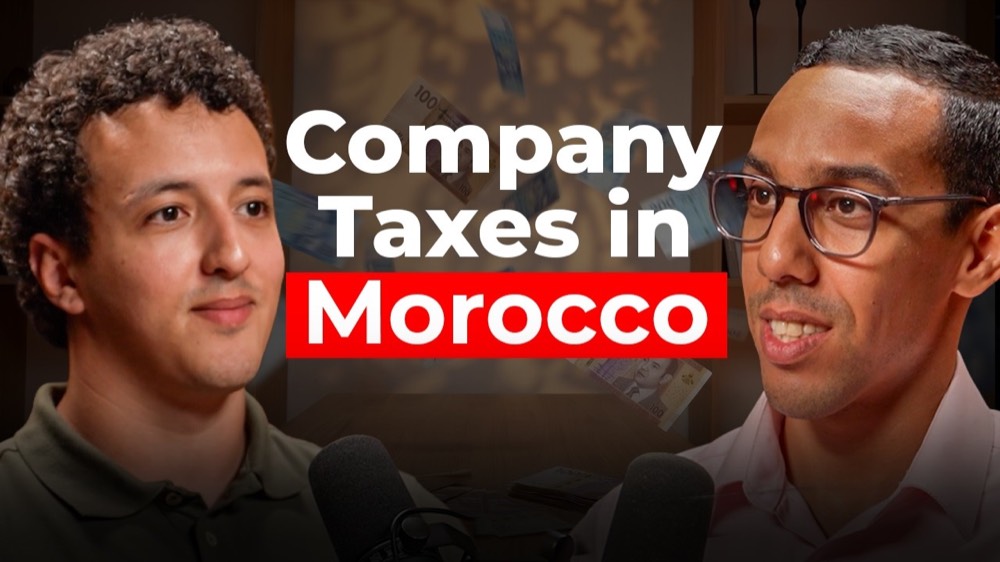
Moncef El Korchi helps entrepreneurs set up and run companies in Morocco. In this conversation he walks through the choices a founder, a Moroccan living abroad (MRE) or a foreigner faces before registering: which legal structure to pick, what it costs, which taxes apply and which exemptions a new company can claim.
Key takeaways
- Foreign investors and MREs can own 100% of a Moroccan company, and can send profits and capital back home if the money entered Morocco through a bank transfer.
- A SARL can be opened 100% online in roughly one week to 15 days, and the formation fees can be under $1,000 depending on the case.
- Moncef recommends the SAS for startups because it is more flexible than a SARL.
- New companies get several exemptions in their first years, including the minimum contribution, VAT on investments and the professional tax.
- Talking to your accountant before every new investment or procedure is the best way to avoid a tax audit.
Can foreigners and MREs start a company in Morocco?
Yes. Moncef explains that a Moroccan living abroad creates a company the same way any Moroccan does. A foreign investor does the same, with one extra step: a business visa to enter the country and invest. Tourists only get a limited stay and would have to leave and come back.
Once in Morocco, he recommends meeting an accountant first. They can tell you whether your activity is eligible, which financing solutions exist and which subsidies and grants you can apply for. Only then should you start the formation.
Foreign investors can own 100% of the shares, just like Moroccan investors.
Can you take your money out of Morocco?
This is one of the biggest worries Yassine hears, and Moncef says it is not true. If you brought your money into Morocco legally, by bank transfer, you can take the capital back out when you close the business, and the procedure is simple. You can also repatriate your profits every year.
The dividend tax is 10% today, down from 15% (it was reduced progressively from 2023). For investors coming from abroad, tax treaties decide the exact rate so you do not pay the tax twice. Morocco has more than 60 of these treaties, so you can check whether your rate is 10%, 0% or another figure.
SARL, SARL AU, SA or SAS: choosing a legal structure
Moncef splits the options into two groups: a physical person (a sole trader, such as the auto-entrepreneur) or a company. For companies, the main forms are the SARL (limited liability company, similar to an LLC), the SARL AU (the same with a single shareholder), the SA for larger companies, and the SAS.
Auto-entrepreneur. Open to foreigners as well. The ceiling is 200,000 MAD per year for services with a 1% tax, and 500,000 MAD per year for trade, industry and crafts with a 0.5% tax. If you go over the ceiling you must switch to another structure. It suits people with a few operations and small profits who do not plan to grow quickly.
SARL. The choice for founders who want to grow, limit personal risk, bring in investors and be taken seriously by banks and clients. Formation fees can be under $1,000, and it takes about one week to 15 days. The whole process can be done online, even for a foreign group opening a Moroccan branch.
SAS. Moncef calls it the best structure for startups. It is more flexible and, unlike the SARL, you do not need a separate shareholders' agreement: the conditions between associates can be written directly into the articles of association.
A subsidiary of a foreign company. The procedure is the same as for a new company. You add a decision from the parent company, for example a US LLC, stating that it is opening a subsidiary in Morocco. That document can be written abroad and joined to the other legal documents.
Comptable agréé or expert-comptable, and how to find a good accountant
Morocco has several kinds of accountants. A comptable agréé is an accountant approved by the government. An expert-comptable (the CPA equivalent) can also do accounting, but can take on extra missions such as audits and certifying the accounts of large companies.
To find a good one, Moncef suggests searching the websites of the professional bodies and, above all, searching on Google, where you can read reviews of each firm. When you contact one, ask whether they already work with companies in your field. Their answer shows quickly whether they fit.
The taxes a Moroccan company pays
VAT on exports. If you sell a service or a product to a client abroad, you are exempt from VAT. The standard rate in Morocco is 20%, with 10% on some goods and services.
Corporate tax. There is no exemption from the first year for most activities: 20% of profit for profits below 100 million MAD and 35% above. Banks and insurance companies pay 40%. Some manufacturing companies and companies in certain free zones are exempt, so ask your accountant about your activity.
Salary and income tax. If you pay yourself a salary, income tax is withheld monthly at a rate from 0% to 37% depending on the bracket. Income under 40,000 MAD per year (about 3,333 MAD a month) is not taxed.
Dividends. 10% if you take them out, nothing if you keep the profits in the company.
Tax exemptions for new companies
Moncef lists three exemptions that matter most at the start:
Minimum contribution (the tax paid when a company makes a loss, 3,000 MAD per year or 0.25% of turnover): exempt for the first 36 months.
VAT on investments, such as machines or a company vehicle: exempt for the first 36 months. You request a certificate of exemption online from the tax administration and buy without VAT. The condition is a bank guarantee for a small amount, released at the end of the exemption period.
Professional tax (*taxe professionnelle*), a local annual tax: exempt for the first five years.
Hiring: the ANAPEC programs
To encourage hiring, ANAPEC offers two contract types, each for 12 months. The first is an internship contract: the employee keeps social security health coverage, the net salary is capped at 6,000 MAD, and the employee pays no tax or contribution. The second has a gross salary cap of 10,000 MAD: the employee is exempt from income tax and the company is exempt from its share of the social contributions to CNSS, while the employee still pays their own part.
Moncef's example: for a minimum-wage employee, the employer contribution is roughly 1,000 MAD a month, and under the program it drops to about 250 MAD. Either the accountant or the entrepreneur can file the requests. Other options in Moroccan law include fixed-term, open-ended and replacement contracts.
Paying for Facebook ads and other foreign services
A common question is whether a company can pay for services abroad, such as Facebook or Instagram ads, from its Moroccan account. Moncef says it can. If you sell services abroad, you can keep 70% of the foreign currency you receive in a currency account and use it for purchases abroad, while 30% must be converted into dirhams.
Companies with no foreign clients can ask their bank for a limited currency allowance and must not exceed it. The amount depends on the request. For startups, Moncef says the allowance can go up to 1 million MAD. Check the current rules with your bank or the Office des Changes.
Mistakes that lead to a tax audit
The first one is not talking to your accountant. If you make a new investment or start a new procedure without asking, it can cost far more than expected, because business activity is regulated and mistakes bring penalties in tax, trade and other areas.
Late declarations, late payments and accounting errors also trigger audits. Moncef compares an audit to a police check: sometimes it is routine, but most of the time the administration has a reason.
On expenses, the rule is simple: you can deduct an expense that is really used for your business. Clothes can be deductible for a marketing company that uses them in a photo shoot but not for a consulting firm. Keep the invoice, and make sure it meets the legal conditions, which your accountant can check.
Watch the full conversation
This article is based on the podcast episode with Moncef El Korchi. Prefer to listen? The full video is on YouTube.
Watch the episodeFrequently asked questions
Can a foreigner own 100% of a company in Morocco?
Yes. According to Moncef El Korchi, foreign investors can own 100% of the shares, like Moroccan investors, and they need a business visa to come to Morocco and invest.
How long does it take to open a SARL in Morocco?
Moncef says it takes approximately one week to 15 days, and the process can be done 100% online. Formation fees can be under $1,000, depending on the situation.
Which legal structure is best for a startup in Morocco?
Moncef recommends the SAS for startups because it is flexible and does not require a separate shareholders' agreement. The SARL remains a solid choice for many small businesses.
Can I take profits and capital out of Morocco?
Yes, if the money was brought into Morocco legally through a bank transfer. Dividends are taxed at 10%, and tax treaties decide the final rate for foreign investors.
What is the corporate tax rate in Morocco?
As explained in the episode: 20% for profits under 100 million MAD, 35% above that, and 40% for banks and insurance companies. Some activities are exempt.
Mentioned in this episode
- Moncef El Korchi on Instagram
- ANAPEC, the national employment agency
- CNSS, social security fund
- Direction Générale des Impôts, tax administration
- OMPIC, commercial register and IP office
- Office des Changes, foreign exchange office
- SARL on Wikipedia
- SAS on Wikipedia
More from The Moroccan Vault
This article summarizes an interview and is for information only. Tax rules and thresholds change, so confirm figures with a licensed accountant before you act. Transcribed and summarized from the episode; if you spot an error, tell us.